

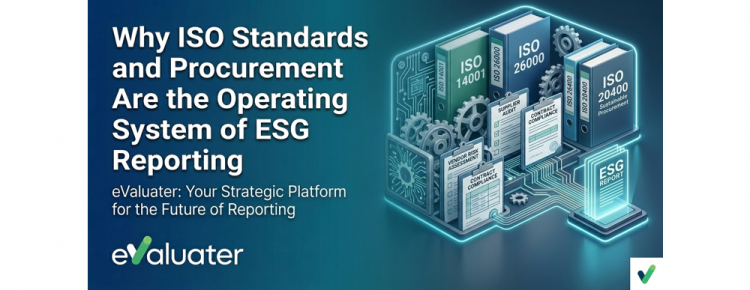
Why ISO Standards and Procurement Are the Operating System of ESG Reporting
I. The End of “Narrative ESG”
For much of the past decade, corporate sustainability reporting functioned as a communications exercise rather than a management discipline. ESG reports emphasized narratives—renewable imagery, philanthropic case studies, and aspirational targets—while the underlying operational systems remained opaque.
That era is ending.
Today’s ESG environment is defined by verification, traceability, and regulatory enforceability. Global investors, regulators, and financial institutions increasingly treat sustainability metrics as decision-grade data rather than marketing content. ESG performance must now withstand the same scrutiny as financial reporting.
Three forces are accelerating this shift:
1. Regulatory convergence – frameworks such as the EU Corporate Sustainability Reporting Directive (CSRD), the UK Procurement Act 2023, and evolving North American disclosure rules are transforming ESG from voluntary reporting to regulated disclosure.
2. Investor materiality – climate risk, supply chain disruption, and human rights violations increasingly appear in enterprise risk registers and credit models.
3. Auditability expectations – ESG metrics must now be traceable, comparable, and auditable, similar to financial statements.
This creates a structural challenge for organizations.
Most ESG frameworks, whether GRI, SASB, TCFD, or emerging ISSB standards, define what to disclose, but not how to operationalize sustainability inside a company.
That is where ISO management system standards enter the picture.
If ESG frameworks define the destination, ISO standards provide the operational blueprint, and procurement becomes the execution engine that embeds sustainability into the enterprise and its supply chain.
II. ISO Standards: The Infrastructure Layer of ESG
ISO standards are frequently misunderstood as compliance checklists. In reality, they represent integrated management architectures designed to embed governance, risk management, and continuous improvement into organizational processes.
Their strategic value lies in three attributes:
- Standardization across global operations
- Auditability through structured management systems
- Integration across environmental, social, and governance domains
Together they form a verifiable operating system for ESG performance.
Environmental Pillar: Operationalizing Climate and Resource Management
Environmental sustainability increasingly revolves around measurable climate and resource data, particularly greenhouse gas emissions, energy consumption, and lifecycle impacts.
Several ISO standards provide the technical backbone:
Environmental Management — ISO 14001
ISO 14001 Environmental Management Systems establishes the foundational framework for environmental management systems (EMS).
It requires organizations to:
- Identify environmental aspects and impacts
- Establish measurable environmental objectives
- Implement monitoring and continuous improvement processes
The structure aligns closely with ESG reporting expectations around risk management, governance, and performance measurement.
Climate Accountability — ISO 14064
ISO 14064 Greenhouse Gas Accounting Standard provides methodologies for quantifying and verifying greenhouse gas emissions.
It underpins credible reporting of:
- Scope 1 and Scope 2 emissions
- Scope 3 value chain emissions
- Carbon reduction targets and verification
For sustainability leaders, ISO 14064 enables auditable carbon accounting, which is increasingly required for regulatory disclosures and climate-related financial reporting.
Energy Management — ISO 50001
ISO 50001 Energy Management Systems focuses on systematic energy performance improvement, enabling organizations to reduce operational energy intensity through structured monitoring and optimization.
The standard supports both decarbonization strategies and operational cost savings.
Climate Integration Across Management Systems
A notable development occurred in 2024 with the amendment to ISO 9001 Quality Management Systems.
The ISO 9001:2015/Amd 1:2024 Climate Action amendment requires organizations to explicitly evaluate whether climate change is a relevant issue to their operations and stakeholders when defining the context of their management system.
This change is significant for two reasons:
- It signals that climate risk is no longer confined to environmental management systems.
- It embeds climate considerations into core organizational governance and operational planning.
In effect, sustainability considerations are migrating from a specialist function into enterprise management architecture.
Social Pillar: Human Capital, Safety, and Responsible Business
Social performance is often the least standardized dimension of ESG, yet several ISO frameworks provide structured guidance.
Occupational Health and Safety — ISO 45001
ISO 45001 Occupational Health and Safety Management Systems establishes systematic approaches to workplace safety, risk mitigation, and worker participation.
It strengthens ESG performance in areas such as:
- workforce well-being
- operational risk management
- incident prevention and safety culture
Social Responsibility — ISO 26000
ISO 26000 Guidance on Social Responsibility provides a comprehensive framework for responsible organizational behavior, including:
- human rights due diligence
- fair operating practices
- community engagement
- responsible supply chains
Although not a certifiable standard, ISO 26000 functions as a strategic reference for ESG policy development.
Governance Pillar: Ethical Infrastructure
Governance standards provide assurance that sustainability commitments are supported by transparent and ethical management structures.
Two standards are particularly relevant:
Anti-Bribery Management — ISO 37001
ISO 37001 Anti?Bribery Management Systems helps organizations implement anti-corruption controls, risk assessments, and whistleblower protections.
Information Security — ISO/IEC 27001
ISO/IEC 27001 Information Security Management establishes frameworks for safeguarding data integrity, confidentiality, and governance.
Together these standards strengthen organizational credibility and accountability, key governance dimensions in ESG ratings and regulatory scrutiny.
III. Procurement: The Hidden Center of ESG Impact
While ISO standards establish internal governance structures, procurement determines whether sustainability commitments actually materialize across the value chain.
Research consistently shows that most corporate environmental and social impacts occur outside the company’s direct operations.
For many sectors:
- 60–70% of total ESG risk resides in supply chains
- Up to 90% of environmental impact can occur upstream through purchased goods and services
This is particularly evident in industries such as:
- manufacturing
- energy
- consumer goods
- technology hardware
These impacts fall into the category known as Scope 3 emissions and value chain impacts.
Managing them is one of the greatest operational challenges in modern sustainability.
ISO 20400: Sustainable Procurement as Strategy
ISO 20400 Sustainable Procurement provides a framework for integrating sustainability into procurement processes.
It transforms procurement from a cost-optimization function into a strategic ESG lever.
Key principles include:
- supplier ESG risk assessment
- lifecycle cost analysis
- responsible sourcing policies
- supplier engagement and improvement programs
Rather than simply selecting the lowest-cost vendor, organizations assess total lifecycle value, including environmental impact, social practices, and governance integrity.
Procurement thus becomes the operational gateway through which ESG standards enter the supply chain.
IV. The Greenwashing Reckoning
Despite rapid progress, ESG implementation faces substantial challenges.
The Standardization Gap
ESG reporting frameworks remain fragmented. Organizations must navigate multiple standards including:
- GRI
- SASB
- TCFD
- ISSB
- CSRD requirements
ISO standards help fill this gap by providing operational management systems, but the broader reporting ecosystem still lacks full harmonization.
Compliance Burden and Supplier Inequality
Small and medium-sized suppliers often struggle to meet ESG reporting expectations.
Without support, strict compliance requirements may unintentionally:
- exclude smaller vendors
- reduce supply chain diversity
- increase procurement costs
Leading organizations address this through supplier capability building programs, helping partners adopt standardized management systems.
The Financial Performance Debate
A long-running debate asks whether strong ESG performance correlates with superior financial returns.
Evidence remains mixed, but one reality is clear:
- Poor ESG performance increasingly leads to regulatory penalties, investor divestment, and reputational damage.
- From a risk management perspective, ESG integration is rapidly becoming a baseline expectation rather than a competitive differentiator.
V. Technology and the Next Phase of ESG Management
The next evolution of ESG will be driven by digital infrastructure capable of handling large-scale sustainability data.
Three technologies are particularly transformative.
AI and Advanced Analytics
Artificial intelligence can analyze supplier data across thousands of entities, identifying:
- emissions anomalies
- governance risks
- labor violations
- compliance gaps
AI systems increasingly support predictive ESG risk detection, allowing companies to intervene before issues escalate.
Blockchain for Traceability
Blockchain technology enables immutable supply chain records, providing traceability for:
- ethical sourcing claims
- carbon accounting
- product lifecycle data
This is particularly valuable for industries with complex multi-tier supply chains.
Integrated ESG and Financial Reporting
The future of corporate reporting is integrated reporting, where financial and sustainability metrics are treated with equal rigor.
In such systems:
- carbon becomes a measurable liability
- resource efficiency becomes a cost metric
- social risks become enterprise risks
ESG metrics evolve from narrative disclosures into decision-critical operational data.
VI. Strategic Layer: How eValuater Enables Supply Chain ESG Intelligence
For most enterprises, the greatest ESG blind spot lies deep within their supplier networks.
Traditional procurement systems track cost, delivery, and quality, but they rarely provide structured ESG intelligence across thousands of suppliers and multiple tiers.
This is where eValuater becomes strategically valuable.
eValuater functions as an AI-driven ESG intelligence layer for supply chains, enabling sustainability and procurement leaders to transform fragmented supplier data into actionable insights.
Key capabilities include:
Multi-Tier ESG Risk Visibility
eValuater aggregates ESG data across supplier networks, helping organizations identify:
- environmental risk hotspots
- labor and human rights concerns
- governance vulnerabilities
- regulatory compliance gaps
This provides sustainability leaders with visibility beyond Tier-1 suppliers, where most ESG risks originate.
ISO-Aligned Supplier Assessment
eValuater maps supplier performance against key ISO frameworks. This allows organizations to evaluate suppliers not just on cost and delivery, but on operational sustainability maturity.
Automated ESG Data Collection
Collecting ESG data from suppliers is often a manual and time-consuming process.
eValuater streamlines this by:
- automating supplier ESG surveys
- standardizing data inputs
- validating information through AI-assisted analysis
This dramatically reduces the administrative burden of supply chain reporting.
Scope 3 Emissions Intelligence
For organizations preparing for regulatory disclosures, Scope 3 emissions are one of the most difficult metrics to measure.
eValuater helps companies analyze value chain emissions data, supporting compliance with emerging regulatory requirements.
Decision-Grade ESG Insights for Procurement
By integrating ESG intelligence into procurement workflows, eValuater enables organizations to:
- prioritize responsible suppliers
- mitigate supply chain risks
- align purchasing decisions with sustainability targets
In essence, it converts ESG data from static reporting into operational decision-making intelligence.
VII. From ESG Aspirations to Operational Reality
The transformation underway in corporate sustainability is structural.
The future of ESG will not be defined by narrative commitments or aspirational pledges. It will be defined by verifiable systems, auditable data, and accountable supply chains.
ISO standards provide the management architecture. Procurement provides the execution channel.
Digital platforms like eValuater provide the data intelligence layer required to manage ESG across complex global supply networks.
Organizations that successfully integrate these elements will not simply produce better sustainability reports, they will build resilient, transparent, and future-ready enterprises.
Tags: iso, standards, ESG, reporting, evaluater