

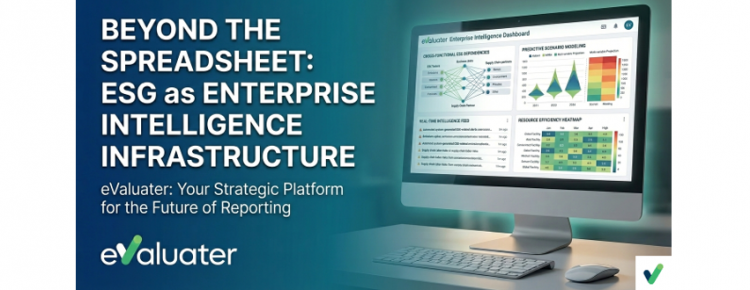
Beyond the Spreadsheet: ESG as Enterprise Intelligence Infrastructure
I. The End of Peripheral Sustainability
The “check-the-box” sustainability report is not evolving, it is obsolete.
What has changed is not the vocabulary of ESG, but its location within the enterprise.
Sustainability data now:
- Enters statutory filings
- Triggers legal exposure
- Influences credit risk
- Shapes capital allocation
- Impacts executive compensation
- Drives procurement eligibility
Under the Corporate Sustainability Reporting Directive (CSRD), sustainability disclosure is enforceable, digitally tagged, and subject to third-party assurance. The International Sustainability Standards Board (ISSB) has embedded sustainability risk into financial reporting architecture via IFRS S1 and S2.
This is no longer ESG reporting. It is enterprise disclosure infrastructure. And spreadsheets cannot support infrastructure.
II. From Data Collection to Decision Architecture
The defining challenge for sustainability directors in 2026 is not measurement, it is translation.
Most organizations now collect more ESG data than they can operationalize. The competitive advantage lies in converting structured sustainability data into:
- Risk-weighted decision models
- Capital allocation signals
- Procurement criteria
- Scenario-tested resilience plans
- Investment screening logic
The companies pulling ahead have shifted from “reporting outputs” to decision engines.
III. Double Materiality as Risk Modeling, Not Workshop Exercise
Under CSRD, double materiality is mandatory. But compliance is the lowest bar.
Advanced teams treat double materiality as:
- Enterprise risk mapping
- Dependency analysis
- Impact quantification
- Financial stress testing
The two lenses are distinct:
Outside-in (financial materiality):
How do climate, biodiversity loss, water stress, regulatory change, or social instability impact enterprise value?
Inside-out (impact materiality):
Where does corporate activity create environmental or social exposure that may convert into regulatory, reputational, or litigation risk?
When rigorously applied, double materiality reshapes:
- CAPEX prioritization
- Supplier selection
- Product portfolio strategy
- Geographic exposure decisions
When superficially applied, it becomes regulatory liability.
The sophistication of your materiality process increasingly signals governance quality to investors.
IV. The Financialization of ESG
The integration between sustainability and finance is no longer theoretical.
Under ISSB standards, sustainability risks must demonstrate financial connectivity. Climate transition assumptions must align with:
- Asset impairment testing
- Discount rate assumptions
- Forward-looking revenue models
- Cost of capital projections
The U.S. Securities and Exchange Commission climate disclosure framework further reinforces that climate risk is financial risk.
Boards are now asking:
- Is our transition plan capitalized?
- Do our emissions reduction pathways align with planned investments?
- Are we stress-testing supply chain exposure under regulatory change?
- Does our financial forecast assume stable resource availability?
This is where sustainability leaders must operate fluently within financial logic.
If ESG assumptions do not reconcile with financial disclosures, credibility erodes immediately.
V. Supply Chain: The Largest Blind Spot
For most multinational firms, 70–90% of total emissions and significant social risk sit in Scope 3.
Regulators understand this. Due diligence requirements are expanding. Impact traceability is becoming enforceable.
Supplier-level visibility is moving from voluntary to mandatory.
Yet most organizations still rely on:
- Self-reported supplier questionnaires
- Industry-average emissions factors
- Annual static assessments
- Spreadsheet-based consolidation
- This model collapses under assurance.
- High-maturity organizations are implementing:
- Risk-based supplier segmentation
- Continuous ESG performance monitoring
- Tier-n supply chain mapping
- Automated red-flag detection
- Integrated procurement scoring
The value chain is now the unit of risk. If you cannot quantify supplier-level exposure in real time, your enterprise risk model is incomplete.
VI. Assurance Changes Everything
The shift from voluntary disclosure to assurance-grade reporting transforms internal expectations.
Under CSRD, limited assurance is transitioning toward reasonable assurance. That means:
- Defined metric ownership
- Control testing
- Document retention protocols
- Traceable data lineage
- Internal audit integration
Sustainability data must now withstand scrutiny similar to financial reporting controls.
This elevates sustainability functions into governance architecture. The era of narrative-heavy reporting without documentation is over.
VII. The Rise of Predictive Sustainability
Retrospective ESG reporting is strategically insufficient.
Leading firms are deploying advanced analytics to model:
- Carbon pricing impacts under multiple jurisdictional scenarios
- Water scarcity exposure across operating regions
- Climate-driven asset devaluation risks
- Transition cost curves across product portfolios
- Supply chain disruption probabilities
Machine learning models ingest:
- Satellite data
- Weather pattern projections
- Commodity volatility
- Regulatory tracking databases
The spreadsheet has become a simulation environment. Real-time dashboards are replacing annual PDF reports. Decision latency is shrinking.
VIII. Political Volatility and Strategic Reframing
The ESG backlash in certain jurisdictions has not reduced disclosure pressure; it has reframed the language.
High-performing companies now anchor ESG within:
- Operational resilience
- Risk governance
- Capital discipline
- Regulatory preparedness
Rather than retreating, they are embedding sustainability into core enterprise systems, where it becomes less ideological and more structural.
Investors increasingly interpret ESG maturity as a proxy for management competence and forward-looking governance.
IX. Data Governance as the New Differentiator
The central bottleneck is not ambition. It is data governance.
Common failure points include:
- Inconsistent emission calculation methodologies
- Poor version control
- Manual consolidation errors
- Misalignment between sustainability and finance taxonomies
- Weak supplier documentation
Enterprise-grade ESG architecture requires:
- Defined data taxonomies
- Role-based accountability
- Automated validation logic
- API-enabled system integration
- Structured audit trails
- Real-time anomaly detection
The organizations that invest early in this infrastructure reduce long-term compliance cost and regulatory risk. The rest will continually react to crises.
X. The Integrated Future: Data to Decision
The separation between sustainability, finance, risk, procurement, and strategy is dissolving.
The Chief Sustainability Officer and CFO are increasingly co-architects of enterprise resilience.
ESG data now informs:
- M&A diligence
- Capital deployment
- Product innovation
- Geographic expansion
- Insurance underwriting
- Debt pricing
The leaders who succeed in this environment are not those who publish the most comprehensive reports.
They are those who:
- Convert sustainability metrics into decision thresholds
- Embed ESG into capital allocation logic
- Quantify supply chain exposure
- Stress-test strategy under climate and social scenarios
- Align disclosures with financial forecasts
The North Star has shifted. It is no longer quarterly earnings in isolation. It is durable value under systemic volatility. And that requires infrastructure, not spreadsheets.
XI. Enterprise-Scale Supply Chain Intelligence: Where eValuater Fits
If ESG has become enterprise infrastructure, the supply chain is its most volatile node.
For most multinational organizations:
- 70–90% of emissions sit in Scope 3
- The majority of human rights exposure is upstream
- Deforestation, biodiversity, and water risk are embedded in procurement
- Regulatory liability extends beyond Tier 1 suppliers
Yet the operational reality inside many companies remains fragmented:
- Static supplier questionnaires
- Annual self-attestations
- Spreadsheet-based risk scoring
- Limited traceability beyond direct vendors
- Reactive remediation workflows
This model does not scale under CSRD assurance requirements, ISSB-aligned financial connectivity, or expanding due diligence mandates.
From Questionnaires to Continuous Risk Intelligence
eValuater transforms supplier ESG oversight from periodic compliance to continuous intelligence.
At enterprise scale, this enables:
- Standardized ESG supplier assessments aligned to global frameworks and configurable to company-specific material risks
- Structured evidence collection with document validation and timestamped audit trails
- Risk-based supplier segmentation, prioritizing oversight where exposure is greatest
- Real-time visibility into compliance gaps and performance shifts
Instead of relying on self-reported narrative responses, sustainability and procurement teams gain structured, comparable, defensible data.
Scope 3 and Impact Quantification Infrastructure
As Scope 3 reporting matures from estimation to defensible quantification, supplier-level data integrity becomes decisive.
eValuater supports:
- Centralized supplier ESG performance tracking
- Emissions and risk data consolidation at portfolio level
- Gap identification aligned to transition targets
- Data export compatibility with enterprise ESG reporting systems
This reduces reliance on industry averages and improves the precision of financial climate modeling.
When sustainability data feeds directly into capital allocation and transition planning, granularity matters.
Assurance-Ready Architecture
Under regimes like the Corporate Sustainability Reporting Directive, sustainability disclosures are subject to third-party verification.
eValuater supports assurance-readiness through:
- Documented submission histories
- Version control
- Transparent scoring logic
- Defined user accountability
- Centralized evidence repositories
This strengthens internal control environments and reduces greenwashing exposure.
For sustainability directors, the shift is critical:
From “we believe our suppliers comply”
To “we can demonstrate supplier performance with traceable evidence.”
ESG as Procurement Leverage
Forward-looking organizations are embedding ESG directly into procurement decision logic.
With eValuater, companies can:
- Integrate ESG scoring into supplier onboarding
- Weight sustainability performance in RFP evaluation
- Identify systemic risk clusters across geographies
- Drive improvement through structured feedback and benchmarking
This moves ESG from reporting output to procurement strategy.
The supply chain becomes not just a source of exposure, but a lever for competitive differentiation.
Infrastructure, Not Overlay
As ESG matures into regulated enterprise disclosure architecture, supply chain intelligence cannot remain fragmented.
eValuater functions as a control layer that:
- Connects sustainability, procurement, and risk teams
- Transforms supplier ESG data into decision-grade intelligence
- Scales across global operations
- Supports regulatory compliance while strengthening resilience
In a landscape where ESG assumptions influence financial disclosures and capital markets perception, upstream opacity is no longer defensible.
Enterprise ESG is only as strong as its weakest supplier node. And infrastructure, not spreadsheets, determines strength.
Tags: ESG, reporting, datamanagement, evaluater, esg software, sustainability managment