

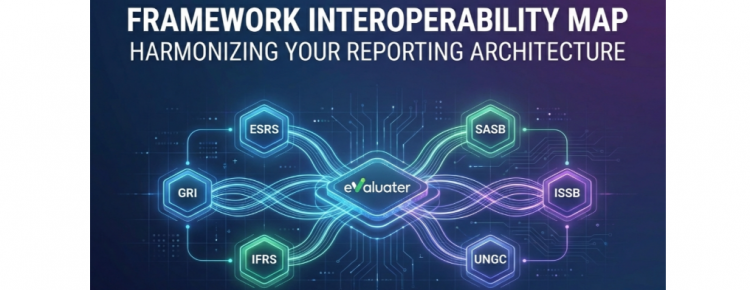
Framework Interoperability Map
Harmonizing Your Reporting Architecture
In 2026, we have finally moved past the "alphabet soup" era and into the Era of Convergence. For the sustainability leader, the question isn't whether to choose IFRS or GRI, it's how to architect a "report once, disclose many" workflow.
The following map and deep-dive decode the 10 critical standards and how they now interlock to form a unified global baseline.
The 2026 Interoperability Map
Modern reporting is no longer a collection of silos; it is a nested ecosystem.
| The Financial Baseline (Investors) | The Impact Baseline (Stakeholders) | The Integrated Giant (Mandatory) |
| IFRS S1 & S2 (incorporates SASB, TCFD, CDSB) | GRI Standards (Impact materiality) | ESRS (CSRD) (Double Materiality) |
| Focus: Enterprise Value | Focus: External Impact | Focus: Both |
The Converging Stream
IFRS S2 is the "engine" for climate data; CDP is the delivery platform.
TNFD is the "blueprint" for nature; ISSB (Nature Draft) is the upcoming regulation.
GRI and ESRS have a "reciprocal digital taxonomy," meaning reporting to one significantly populates the other.
Deep Dive: The 10 Standards (2026 Update)
1. IFRS Sustainability Disclosure Standards (S1 & S2)
Released in June 2023 by the ISSB (established in 2021), these standards are the global baseline for reporting ESG data to investors. Built on the SASB Standards and TCFD, they include IFRS S1 (General Disclosures) and IFRS S2 (Climate). In November 2025, the ISSB initiated a standard-setting process for nature-related risks (drawing on TNFD). An initial draft is targeted for October 2026. Research is also underway for a potential human capital standard involving workforce and supply chain labor.
2. SASB Standards
Now part of the IFRS Foundation, SASB provides the industry-specific "how-to" for identifying financially material risks across 77 sectors. They are the granular metrics that breathe life into IFRS S1 and S2.
3. GRI Standards
The gold standard for impact materiality. As of 2025/2026, GRI's new Climate Change and Energy standards require specific data on "Just Transition," ensuring companies report on the human impact of their green shifts.
4. ESRS (European Sustainability Reporting Standards)
Mandatory for those under the EU’s CSRD. In early 2026, the Omnibus I package simplified these standards, reducing mandatory data points by 61% to focus on what is truly material. It is now highly aligned with IFRS S1 for financial materiality definitions.
5. CDP (formerly Carbon Disclosure Project)
The primary mechanism for voluntary disclosure to capital markets. In 2026, the CDP questionnaire is fully aligned with IFRS S2, making it the most efficient way to get your S2-aligned data into the hands of over 700 institutional investors.
6. TNFD (Taskforce on Nature-related Financial Disclosures)
Following a massive surge in adoption, the TNFD is completing its final technical work in Q3 2026. It will then pause to support the ISSB in creating the permanent global nature standard. Its LEAP approach remains the recommended method for nature-risk assessment.
7. UN Global Compact (UNGC)
Focused on 10 universal principles. In 2026, the UNGC transitioned to a standardized digital Communication on Progress (CoP), moving away from narrative essays toward hard data on human rights, labor, and environment.
8. TCFD Recommendations (Legacy/Integrated)
The Task Force disbanded in 2023, but its four pillars—Governance, Strategy, Risk, and Metrics—are now the legal "skeleton" of the IFRS standards and the SEC’s climate rules.
9. CDSB Framework (Legacy/Integrated)
Also absorbed by the IFRS, the CDSB’s principles for including environmental information in financial filings have been codified into IFRS S1, ensuring sustainability data is treated with the same rigor as financial data.
10. WDI (Workforce Disclosure Initiative)
Now a critical tool for the "S" in ESG, the WDI provides the granular workforce and supply chain data required by the CSDDD (Corporate Sustainability Due Diligence Directive).
How to Decide: The Strategic Selection Process
It can be confusing to sort out which framework, or combination, will best suit your organization. Consider these factors:
The Data You Have: Are you ready for audit-grade financial integration (IFRS) or starting with impact-based storytelling (GRI)?
Stakeholder Demands: Investors want SASB/IFRS; customers and employees want GRI/UNGC.
Reporting Mandates: If you have EU operations, ESRS is mandatory. In California, IFRS S2 (via TCFD) is your benchmark.
Industry Standards: Most sectors have a "default" framework. Deviating can make you harder to compare against peers.
Program Maturity: Start with the UNGC principles-based approach if you are early-stage; move to IFRS/ESRS as your governance matures.
Pro-Tip: Because these frameworks were created for different purposes, it is now common (and recommended) to use a Hybrid Approach.
Operationalizing the Map: How eValuater Helps
The ongoing consolidation of these frameworks is making it easier to combine them, but the "manual work" of mapping remains a hurdle. eValuater acts as your Convergence Engine:
Integration & Alignment: eValuater simplifies complex compliance by pre-mapping GRI, ESRS, and IFRS frameworks directly within your templates so that you can connect a single strategic initiative to multiple global standards simultaneously.
Audit-Ready Governance: As the ISSB nature draft arrives in October 2026, eValuater’s workflows ensure your data is already collected under the correct governance controls.
Strategic Clarity: It turns the "alphabet soup" into a dashboard of strategic actions, ensuring that reporting is the result of your strategy, not the burden of it.
eValuater empowers your Governance. It provides the structure, the framework alignment, and the audit-ready workflow that turns a compliance headache into a strategic competitive advantage.
Tags: interoperability, ifrs, esrs, gri, ungc, tnfd, evaluater, ESG