

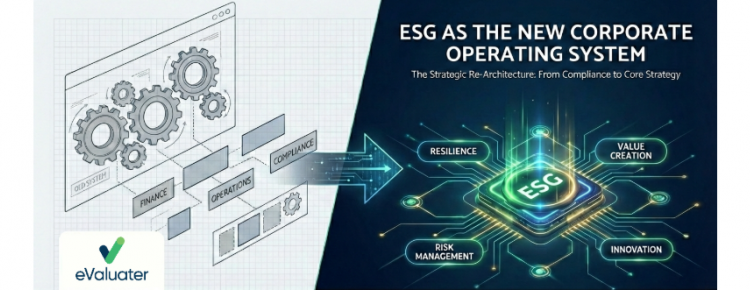
The Strategic Re-Architecture: ESG as the New Corporate Operating System
The era of "voluntary disclosure" is officially in the rearview mirror. With the TCFD disbanded and its monitoring responsibilities absorbed by the IFRS Foundation, we have moved from the "Wild West" of sustainability reporting to a period of rigorous, standardized financial integration.
For the sustainability expert, this isn't just about switching logos on a report. It’s about re-engineering the corporate strategy to thrive in a high-transparency, low-carbon economy.
1. The ISSB Pivot: Quantifying Resilience
With the global adoption of IFRS S1 (General Requirements) and S2 (Climate-related Disclosures), climate risk is no longer a footnote, it is a line item. The strategic focus has shifted from qualitative "climate stories" to the quantification of how these risks impact a company’s financial position and cash flows.
Strategic Challenge: Moving from narrative to Value at Risk (VaR). Boards need to know not just that you have a climate plan, but how that plan affects your Weighted Average Cost of Capital (WACC).
How eValuater Helps: Expert-level sustainability strategy requires a shift from retroactive data gathering to structural alignment. eValuater serves as your Disclosure Architect, providing the framework to map your organization’s core strategic initiatives directly against the rigorous mandates of IFRS S1 and S2.
2. The Double Materiality Nexus (CSRD/ESRS)
For those navigating the CSRD, "Double Materiality" is the new strategic frontier. It’s no longer enough to look at how the world affects your P&L (Financial Materiality); you must account for your impact on the world (Impact Materiality).
Strategic Challenge: Identifying "stranded assets" and systemic risks before they manifest as financial losses. A robust Double Materiality Assessment (DMA) is essentially a 10-year risk-management roadmap.
How eValuater Helps: eValuater provides the Strategic Framework for DMAs. Instead of managing the complexity of the European Sustainability Reporting Standards (ESRS) in disconnected spreadsheets, the platform provides a centralized environment to conduct supplier assessments, score impacts, and determine what is truly material to your specific business model.
3. Decoupling Growth from Impact
Expert-level strategy requires shifting from "reporting on the past" to "planning for the future." This involves aligning capital allocation with Science-Based Targets (SBTi). The goal is to ensure that for every dollar of growth, there is a measurable decrease in environmental intensity.
Strategic Challenge: Prioritizing CAPEX/OPEX. Strategy leads need to evaluate which decarbonization projects offer the best "marginal abatement" without relying on the crutch of low-quality offsets.
How eValuater Helps: eValuater acts as your Strategy Control Tower. While you bring the emissions data from your technical teams, eValuater allows you to track progress against your stated strategic goals. It provides the visibility needed to identify gaps in your transition plan, ensuring your sustainability roadmap remains aligned with your broader corporate objectives.
4. Supply Chain Sovereignty: Navigating the CSDDD
The Corporate Sustainability Due Diligence Directive (CSDDD) has turned the "S" in ESG into a significant legal liability. Strategic planning now requires a radical transparency across the value chain, shifting from "vendor management" to "value chain resilience."
Strategic Challenge: Managing human rights and environmental risks in Tier 2 and Tier 3 suppliers where visibility is historically low.
How eValuater Helps: eValuater facilitates the Governance of Supply Chain Due Diligence. It provides the structured workflows needed to collect, verify, and store supplier assessments. It creates a defensible record of your due diligence efforts, ensuring that your organization can demonstrate "reasonable steps" in the event of a regulatory inquiry.
The Alpha of Sustainability
In the post-TCFD world, "Alpha" is no longer found in the act of reporting, it is found in the integrity of the strategy being reported. The role of the sustainability lead has evolved into a hybrid of a Chief Risk Officer and a Chief Strategy Officer.
eValuater doesn't replace your data; it empowers your Governance. It provides the structure, the framework alignment, and the audit-ready workflow that turns a compliance headache into a strategic competitive advantage.
By instantly mapping your data to the latest frameworks like GRI, IFRS, ESRS, UNGC, eValuater provides the easy, fast, and affordable bridge between financial risk and environmental impact.
Don't waste months on manual spreadsheets, future-proof your reporting today and make compliance the most manageable part of your business strategy.