

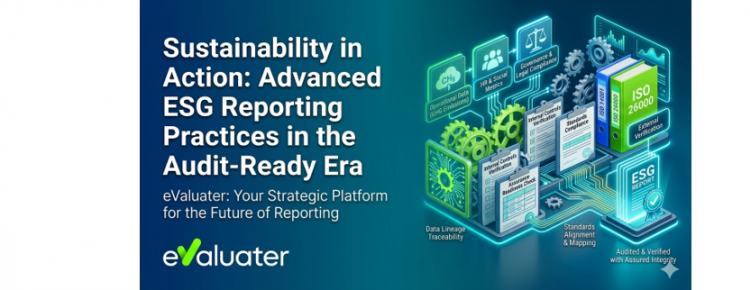
Sustainability in Action: Advanced ESG Reporting Practices in the Audit-Ready Era
I. The End of Narrative ESG
The era when sustainability reports functioned primarily as corporate storytelling has effectively ended.
By 2026, ESG disclosure has entered what many governance experts describe as the “audit-ready phase” of sustainability reporting. In this phase, environmental, social, and governance data is evaluated through the same governance and assurance mechanisms applied to financial information.
Three forces have accelerated this transformation:
- Regulatory mandates requiring standardized ESG disclosure
- Institutional investors integrating climate and sustainability risks into valuation models
- Technological advances enabling large-scale ESG data verification
The practical consequence is straightforward:
If sustainability data cannot be verified, traced, and audited, it is no longer decision-grade information.
This shift has elevated ESG reporting from a communications function to an enterprise governance system, requiring alignment between sustainability leaders, finance departments, procurement teams, and internal audit functions.
II. The Global ESG Reporting Architecture
The modern ESG landscape is defined by two dominant disclosure paradigms that sustainability directors must navigate simultaneously.
The Financial Materiality Model
The International Sustainability Standards Board has introduced IFRS S1 and IFRS S2 as global sustainability disclosure standards focused on financial materiality.
These standards require organizations to disclose:
- Climate-related financial risks
- Governance oversight structures
- Scenario analysis and transition plans
- Quantitative emissions metrics
Their objective is to ensure that sustainability risks affecting enterprise value are disclosed in a structured and comparable way.
For capital markets, these disclosures represent the baseline language of climate risk governance.
The Double Materiality Model
In contrast, the European Union’s Corporate Sustainability Reporting Directive introduces a broader framework through the European Sustainability Reporting Standards (ESRS).
CSRD requires companies to assess double materiality, meaning they must disclose both:
- Outside-in risks: how environmental and social factors affect company financial performance
- Inside-out impacts: how company operations affect the environment and society
This creates a more complex disclosure environment, but one that provides deeper insight into systemic sustainability impacts across value chains.
For sustainability directors, this means ESG reporting must now connect enterprise risk management, operational performance, and societal impact metrics.
III. ISO Management Systems as the Operational Backbone of ESG
While ESG frameworks define what must be disclosed, ISO management systems define how organizations operationalize sustainability performance internally.
These standards create the structured management processes necessary to produce consistent, auditable ESG data.
Environmental Governance Infrastructure
Several ISO standards form the foundation of environmental accountability.
Environmental Management Systems
ISO 14001 provides a systematic framework for identifying environmental risks, setting performance targets, and implementing continuous improvement processes.
It enables organizations to embed sustainability into operational decision-making rather than treating it as a reporting exercise.
Carbon Accounting
ISO 14064 establishes methodologies for measuring and verifying greenhouse gas emissions.
These methodologies support credible reporting of:
- Scope 1 emissions (direct operations)
- Scope 2 emissions (energy consumption)
- Scope 3 emissions (value chain impacts)
As regulatory scrutiny increases, ISO-aligned carbon accounting frameworks provide the technical foundation for defensible emissions reporting.
Energy Optimization
ISO 50001 helps organizations systematically reduce energy consumption and improve efficiency.
Beyond emissions reduction, the standard enables companies to quantify energy performance improvements and link them directly to operational cost savings.
Social and Governance Management Systems
Social and governance dimensions of ESG are frequently harder to quantify, yet ISO frameworks provide structured guidance.
Examples include:
- ISO 45001 for worker protection and safety performance
- ISO 26000 for human rights and ethical practices
- ISO 37001 for governance integrity
Together, these standards enable organizations to translate ESG commitments into auditable operational controls.
IV. The Strategic Importance of Supply Chain Transparency
One of the most challenging aspects of ESG reporting is the measurement of value chain impacts.
Research across multiple industries consistently shows that the majority of ESG risk occurs outside direct corporate operations, particularly in complex global supply chains.
For many organizations:
- Scope 3 emissions represent 70–90% of total carbon footprint
- Human rights risks are concentrated among suppliers
- Biodiversity and resource impacts occur upstream in raw material extraction
Managing these risks requires a structured approach to sustainable procurement.
Sustainable Procurement Framework
ISO 20400 provides guidance for integrating environmental and social considerations into supplier selection and contract management.
The standard encourages organizations to evaluate suppliers based on:
- environmental performance
- labor practices
- ethical governance
- lifecycle sustainability impacts
In practice, procurement becomes the primary operational interface between corporate ESG commitments and real-world supply chain performance.
V. Leading ESG Reporting Practices: Lessons from Industry
Organizations that excel in ESG reporting increasingly treat sustainability data as strategic digital infrastructure rather than periodic reporting content.
Examples across industries illustrate different approaches.
Digital Reporting Integration
Major global firms have adopted machine-readable ESG reporting formats such as XBRL, enabling sustainability data to be integrated directly into financial analysis systems used by institutional investors.
This improves data comparability, accessibility, and regulatory compliance.
Scope 3 Supply Chain Management
Advanced ESG leaders have implemented digital supplier monitoring systems capable of evaluating thousands of vendors simultaneously.
These systems allow companies to identify emissions hotspots, assess compliance risks, and prioritize supplier engagement programs.
Real-Time Sustainability Metrics
Organizations increasingly rely on IoT sensors, energy monitoring systems, and digital platforms to collect sustainability data continuously rather than retrospectively.
This shift transforms ESG reporting from a historical disclosure exercise into a real-time management capability.
VI. Strategic ESG Intelligence: The Role of eValuater
As ESG disclosure requirements expand, the complexity of collecting and validating sustainability data across global supply chains has become a major operational challenge.
Many organizations struggle with:
- fragmented supplier data
- manual ESG questionnaires
- inconsistent reporting standards
- limited visibility beyond Tier-1 suppliers
This is where eValuater provides strategic value.
eValuater is an AI-driven ESG intelligence platform designed to strengthen supply chain transparency and reporting accuracy.
ESG Data Intelligence
The platform aggregates sustainability data across supplier networks and applies AI-based analysis to identify:
- environmental risk hotspots
- governance vulnerabilities
- labor and compliance risks
- carbon footprint patterns
This enables sustainability directors to obtain structured insights into supply chain ESG performance.
ISO-Aligned Supplier Assessment
eValuater evaluates suppliers against internationally recognized frameworks, including:
- environmental management systems
- occupational health and safety standards
- sustainable procurement principles
This allows organizations to align supplier monitoring with ISO-based ESG governance frameworks.
Automated ESG Data Collection
Traditional ESG reporting often relies on manual surveys sent to suppliers.
eValuater automates this process by:
- standardizing ESG questionnaires
- validating supplier responses
- identifying data anomalies through AI analytics
This reduces administrative burden while improving data reliability and traceability.
VII. Case Study: Kalyon Enerji
A notable example of ESG intelligence implementation comes from Kalyon Enerji, a major renewable energy developer operating large-scale solar infrastructure.
As the company expanded its energy portfolio, managing ESG performance across complex supplier networks became increasingly challenging.
Kalyon Enerji adopted eValuater to strengthen its sustainability reporting processes and supplier transparency.
Key outcomes included:
Improved Supply Chain Visibility
The platform enabled Kalyon Enerji to monitor ESG performance across its supplier ecosystem, identifying environmental and governance risks early.
Structured Sustainability Reporting
By consolidating ESG data into a unified system, the company improved the accuracy and consistency of its sustainability disclosures.
Operational Efficiency
Automated ESG data collection significantly reduced the time required to gather supplier sustainability information, allowing sustainability teams to focus on risk mitigation and strategic planning.
Alignment with Global Standards
The integration of ISO-aligned evaluation frameworks supported compliance with international sustainability standards and emerging regulatory requirements.
VIII. The Future of ESG Reporting
Looking ahead, ESG reporting will continue to evolve toward real-time sustainability intelligence.
Key trends shaping the next phase include:
- AI-driven ESG analytics
- digital product passports for lifecycle traceability
- integration of nature-related risk disclosures
- automated regulatory compliance systems
These developments will transform sustainability reporting from a static annual report into a continuously updated enterprise risk monitoring system.
IX. Conclusion: The Competitive Advantage of Transparent Systems
The future of ESG reporting will belong to organizations that treat sustainability not as a narrative exercise but as a disciplined system of measurement, governance, and operational transparency.
ISO management standards provide the process architecture.
Regulatory frameworks provide the disclosure requirements.
Digital platforms like eValuater provide the data intelligence needed to manage ESG risks across complex global supply chains.
For sustainability directors, the strategic imperative is clear:
The organizations that succeed in the audit-ready era will be those that convert sustainability data into actionable enterprise intelligence.
Tags: kalyon enerji, case study, sustainability